Lesson 05 · At the table

Food and wine

or why your grandmother was right without knowing it

What it is

Matching food and wine comes down to two ideas, not a thousand rules. Opposites can balance each other: a sharp, lively wine cutting through a rich dish. Or like can answer like: a powerful wine with a powerful dish, a delicate one with a delicate one. Neither is better. And the simplest guide is often the best: what grows in the same region usually gets on well on the same plate.

It is the most practical lesson in the school, because it happens at your own table.

The principle

Two ideas, not a thousand rules

1

Opposites

contrast · two characters that balance

Two opposite characters that balance each other. A lively acidity cutting through the fat of a dish, a bit like lemon squeezed over an oily fish in a butter sauce. Or the deep sweetness of a Sauternes (a rich sweet wine) against the salty, punchy power of a Roquefort (a blue cheese).
2

Like with like

two intensities that answer each other

Two intensities that echo each other instead of clashing, and back each other up instead of cancelling out. A powerful wine with a powerful dish, a delicate wine with a delicate dish: each leaves the other room to linger.

Neither is better than the other. The best guide is often the simplest: what grows in the same region usually ends up getting on well on the same plate.

Regional pairings

The wisdom of the land

  1. Savoie: white wine and fondue or raclette

    The lively acidity of an Apremont or a Roussette, two Savoie whites, cuts through the fat of the melted cheese: pure opposites. But the real genius of the Savoyards lies elsewhere. They turned an evening of melting cheese and emptying bottles of white into an essential winter ritual, almost part of the heritage. All without hiring a single consultant.

    Opposites
  2. Sancerre and Crottin de Chavignol

    Almost too perfect to be true. The goat's cheese takes its name from the hamlet of Chavignol, tucked in among the vines of Sancerre. The mineral liveliness of the Sauvignon, the grape in the glass, echoes the fresh tang of the cheese. Like with like, and nobody had to think about it: the land did the work.

    Like with like
  3. Jura: vin jaune and aged Comté

    Like with like, all the way. Vin jaune, the Jura's "yellow wine", is deliberately oxidative (it is allowed to meet the air) and develops aromas of walnut that run straight into the same notes in a well-aged Comté. The two answer each other without arguing: one of the rare pairings where two almost extreme products end up perfectly on the same side.

    Like with like
  4. Muscadet and Atlantic oysters

    The classic of classics, and the cleverest of the four. The wine is mineral and briny, echoing the sea in the oyster (like with like), while its liveliness cleans up the richness of the flesh (opposites). A pairing that refuses to pick a side, and quite right too.

    Both at once

And our own

Irancy and a Burgundy plate

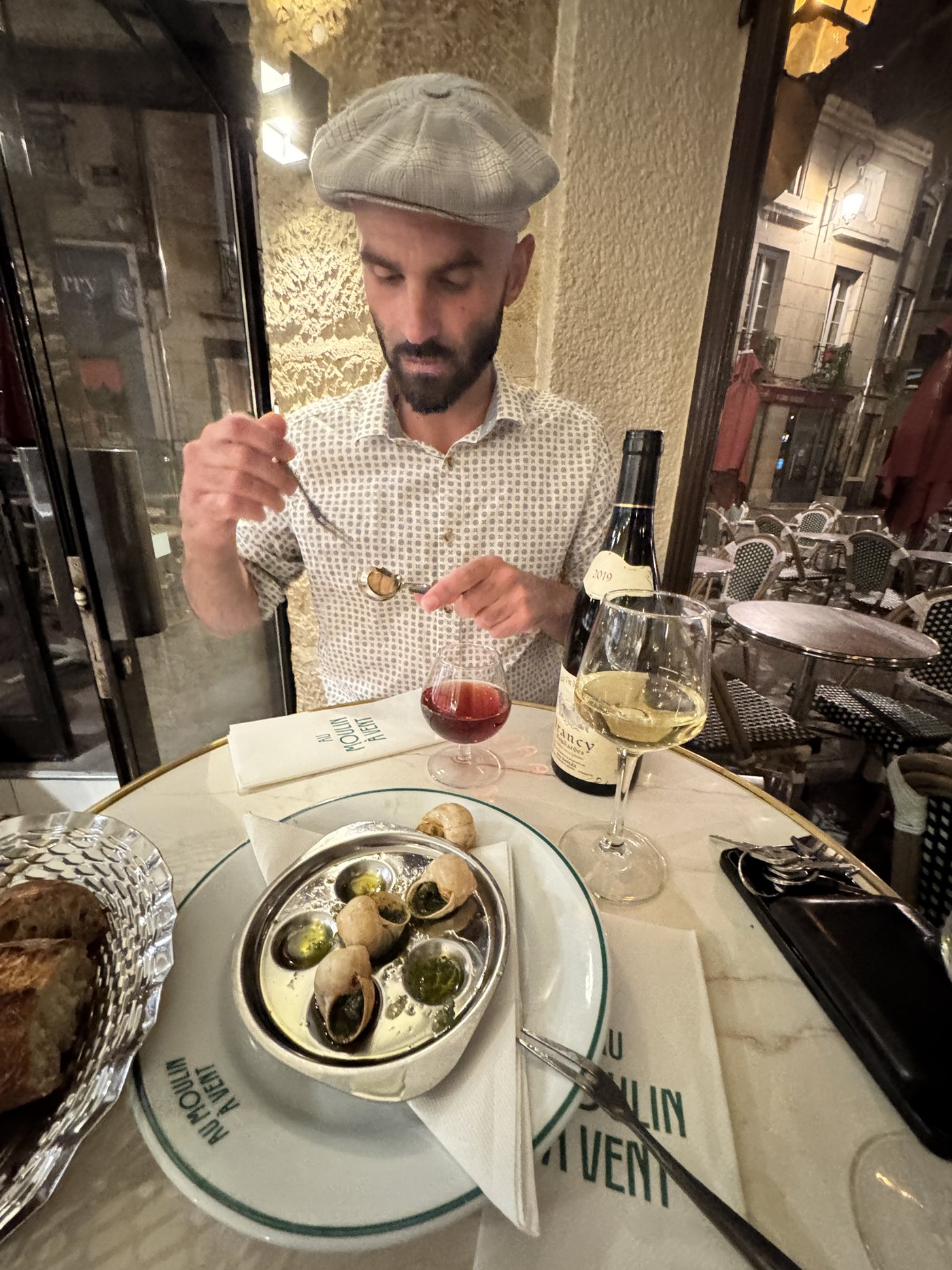
Our first wine, Éric Darles's Irancy, comes from Burgundy, the home of jambon persillé and gougères, and from the Yonne, where Soumaintrain is made a short drive away. As with the pairings above, the land did the thinking. Marcel adds one rule of his own for a young bottle: give it something with protein, cheese or meat, because the protein binds with the tannins and keeps your mouth from drying.

Marcel with a plate of snails, a glass of red and a glass of white

Dijon · snails, as one must · September 2026

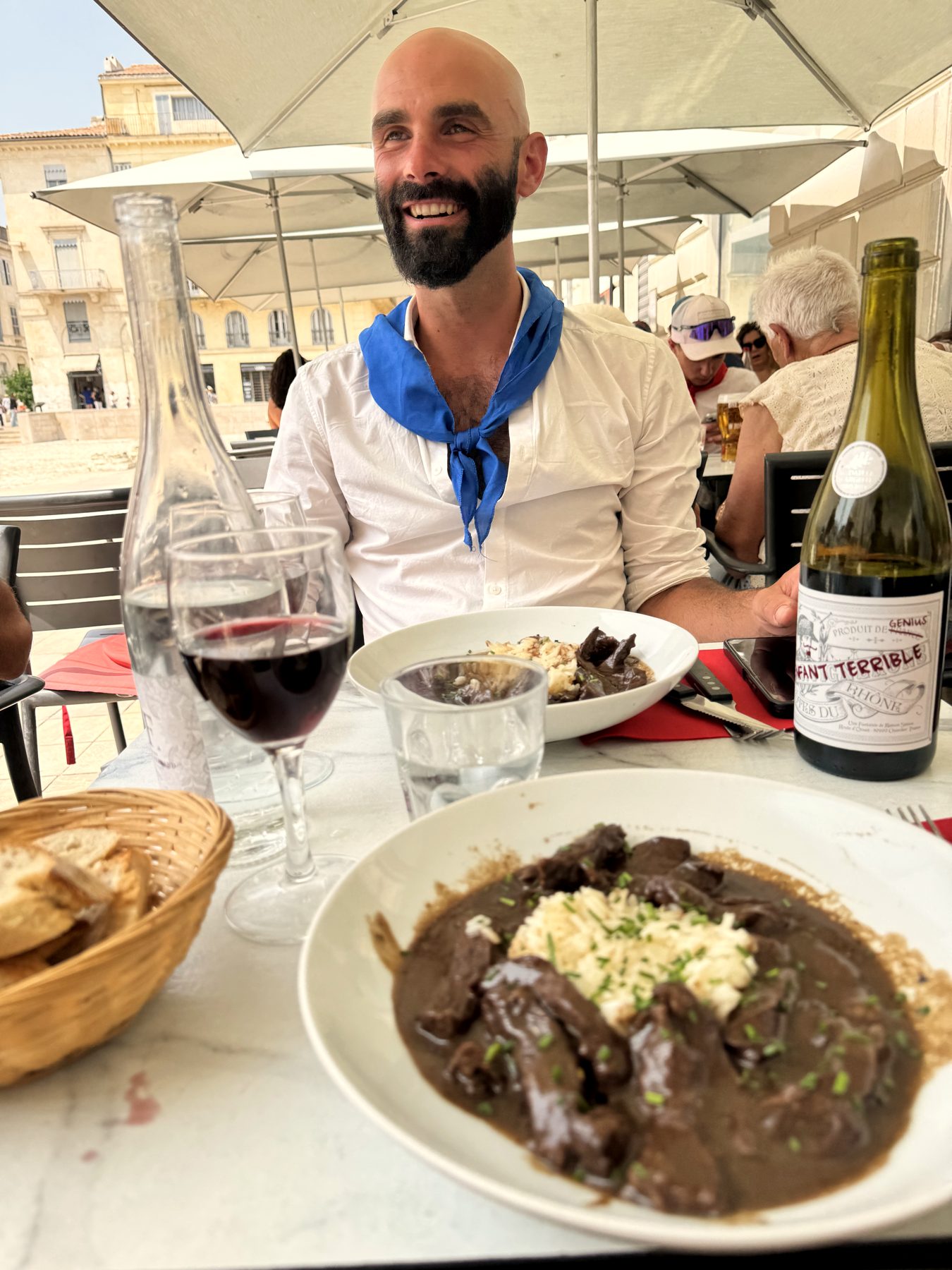
Marcel at a table in Nîmes, blue neckerchief, a glass of red, a plate of daube and a bottle

Nîmes · at the table · June 2025

The traps

What is hard to match

Some foods are not being difficult on purpose. They are just awkward with wine by nature, and we did not invent this: generations of sommeliers wrote it down long before us.

Vinaigrette
Raw vinaigrette, the classic enemy: the vinegar flattens the wine's aromas in the fight.
Hard
Artichaut
Artichoke contains a molecule, cynarin, that makes almost anything you drink afterwards taste oddly sweet. One of the few vegetables with its own reputation as a pairing killer.
Hard
Cuisine très épicée
Very spicy Asian food usually knocks reds out of the game. Better a dry, powerful white, even a slightly sweet one (a Riesling or a Gewurztraminer, say), than hoping a red will go the distance against the chilli.
Hard

To avoid

Pairings that work against you

Some combinations are not just clumsy. They are downright counterproductive.

A tannic red with oysters or any other raw seafood: the iron naturally present in the wine reacts with the seafood and leaves a metallic, almost fishy aftertaste. A classic to avoid, as a rule. A very sweet dessert, above all chocolate, with a dry wine: the sugar flattens the wine's acidity and balance, and it suddenly tastes thin and bitter. The golden rule here: the wine should always be at least as sweet as the dessert. And a very spicy dish with a strong, high-alcohol wine: the alcohol turns up the burn of the chilli instead of calming it. Better a wine lower in alcohol.

At a glance

If you are eatingtry
Oysters, raw seafooda Muscadet, never a tannic red
A chocolate desserta wine at least as sweet as the dessert, not a dry one
A very spicy disha white such as Riesling or Gewurztraminer rather than a red, and nothing too strong in alcohol

What tannin is, and what it does in your mouth: see the Tannins lesson.

What grows in the same region usually gets on well on the same plate.

Wine on its own

The wine that prefers to drink alone

Some wines, on the other hand, are enough on their own. The great sweet wines such as Sauternes can be so concentrated, so rich, that they work as a dessert in their own right. No need to hunt for a clever pairing: a moment of quiet with the glass is plenty. Champagne may go elegantly with almost anything, yet it is probably the only wine we sometimes open just for itself, without a dish in mind at all.

Try it at home

One question

Next time you sit down with a plate and a bottle, ask just one thing: do they complete each other, or echo each other? "Opposites, or like with like?" And if one completely flattens the other, it is nobody's fault. Just a marriage to rethink next time.

The words

Little glossary

accord mets et vinsfood and wine pairing
oppositionopposites: two contrary characters that balance each other
similitudelike with like: two intensities that echo each other
liquoreuxa great sweet wine, such as Sauternes
oxydatifallowed to meet the air on purpose, like vin jaune
iodébriny, tasting of the sea
cynarinecynarin, the molecule in artichoke that makes wine taste oddly sweet